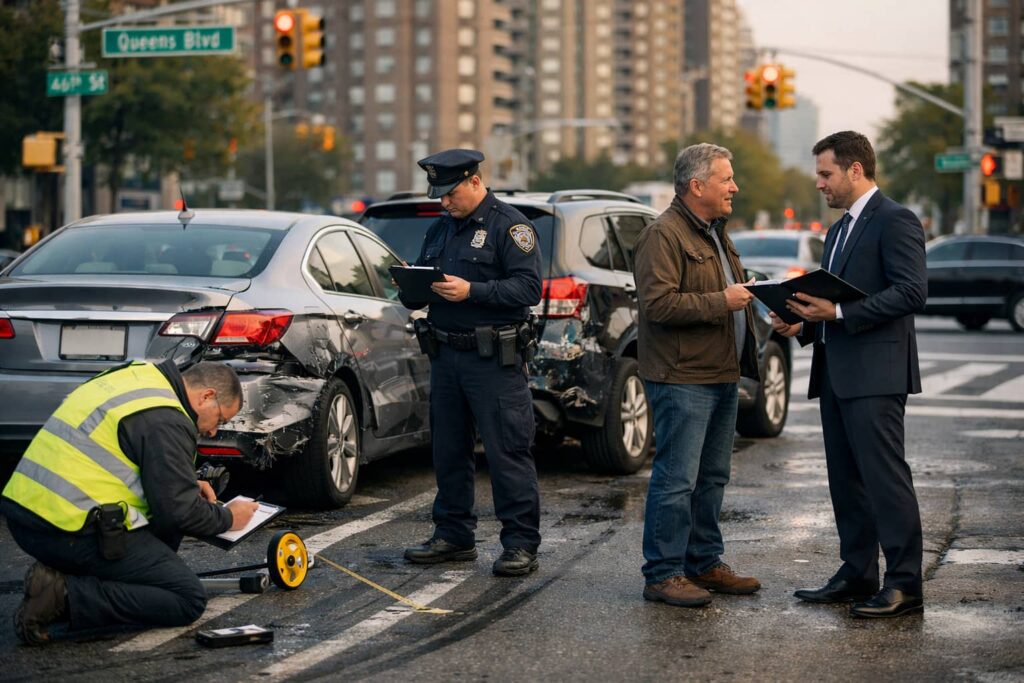
Chain reaction accidents can occur rapidly on New York City streets. One moment, you sit stopped at a red light in Queens or in Manhattan traffic, and the next, two vehicles sandwich you with no way to prevent the collision.
At The Perecman Firm, we've handled hundreds of multi-vehicle accident cases over our 40-plus years representing injured New Yorkers. These crashes create complicated liability questions that insurance companies love to exploit.
Key Takeaways: Liability in Chain Reaction Collisions
- The driver who rear-ended you typically bears liability for your injuries and the damage to the vehicle ahead.
- New York law generally holds the rear driver responsible for failing to maintain a safe following distance.
- You may face liability for striking the car in front only if you acted negligently, such as by following too closely before the impact.
- Multiple drivers can share liability in chain reaction accidents depending on each person's actions before the collision.
- Insurance companies often try to shift blame to the middle driver to reduce what they pay out on claims.
- Gathering evidence immediately after the accident, including photos and witness statements, helps establish the true sequence of events.
- Call a car accident attorney to protect yourself from wrongful blame in multi-vehicle collision cases.
How Chain Reaction Accidents Happen
Chain-reaction collisions occur when one impact causes a vehicle to strike another, often in heavy NYC traffic. You stop for a red light, but a distracted or tailgating driver hits your car, pushing you into the vehicle ahead.
These crashes are especially dangerous for middle drivers, who absorb impact from both directions, causing severe whiplash or spinal injuries. Larger pileups involving multiple vehicles complicate liability. Weather and road conditions, such as rain or snow, increase the risk, but even in clear conditions, distracted driving and following too closely are common causes of multi-vehicle accidents.
The Legal Principle Behind Rear-End Liability
A safe following distance is required under New York traffic law to prevent rear-end collisions. When a driver hits the car in front, courts presume they were at fault for following too closely or not paying attention.
The responsibility to stop safely falls on the rear driver, not the lead vehicle. This presumption protects middle-car victims in chain reaction crashes, as the rear impact pushes you into another car with no chance to avoid it. Insurance companies try to assign shared fault, but the law favors those hit from behind.
When the Rear Driver Bears Full Responsibility
In chain reaction accidents, the rear driver’s liability extends to all damages, including damage to your vehicle, damage to the vehicle ahead, and injuries to everyone involved. Their negligence sets the collision in motion, so they are responsible even if they didn’t directly hit the front car.
Insurance coverage from the rear driver should pay for repairs and injuries, regardless of the severity of damage to the front vehicle. Strong documentation, police reports, and witness statements confirm the sequence of events and reinforce your claim, making it harder for insurers to dispute liability.
Situations Where You Might Share Liability
Shared liability can arise in chain reaction accidents, reducing the rear driver’s responsibility and the compensation you can recover. You might share fault if you were following too closely, as insurers argue a proper distance may have prevented the secondary collision.
Sudden stops without a valid reason, or failing to stop for traffic signals or hazards, can also shift blame. Defective brake lights create potential liability if the rear driver couldn’t see you slowing. Distracted driving on your part, such as texting just before impact, may be used to argue that you contributed to the collision with the front vehicle. Each scenario depends on evidence proving these conditions existed.
The Three-Car Liability Analysis
Analyzing multi-vehicle collisions in chain-reaction accidents requires examining each driver’s actions individually. Fault isn’t automatic for the rear driver just because they caused the first impact. Middle driver liability arises if you contributed to the collision with the car ahead, such as by following too closely or failing to brake safely.
Full rear driver liability applies when you were stopped safely and had no opportunity to avoid the front collision. Causation is key: courts and insurers determine whether the rear driver’s negligence caused all damage or if your actions independently contributed. Evidence like traffic conditions, spacing, and witness statements establishes who is responsible for each impact.
How Insurance Companies Exploit Confusion
Insurance tactics in chain reaction accidents exploit the confusion caused by multiple impacts. Adjuster questioning begins soon after the crash, with leading questions designed to shift blame and reduce payouts.
Rear-driver claims often argue that you should have prevented hitting the front car, ignoring the physics of being struck from behind. Front-driver claims may assert that you followed too closely to avoid their damage. Independent strategies by multiple insurers create conflicting narratives, making liability appear uncertain. Legal representation ensures these tactics don’t undermine your claim and that responsibility is accurately assigned.
Evidence That Establishes the True Sequence
Photographs and Vehicle Damage
Photos of your vehicles provide immediate, objective evidence. Rear bumper damage shows you were struck from behind, while front bumper damage proves you contacted the car ahead. Spacing and impact patterns help confirm you were pushed forward and not following too closely.
Vehicle Positions and Witness Accounts
The final resting positions of all cars reveal the collision sequence. Witnesses, including drivers, passengers, or pedestrians, offer independent confirmation of your safe distance and actions before impact. Their testimony carries significant credibility.
Video and Official Reports
Traffic or police body camera footage can capture key details showing the dynamics of the accident. The police report documents the officer’s assessment of fault and provides influential support for your claim. Combined, these elements form a strong foundation to counter insurance company tactics and establish the true sequence of events in a chain reaction accident.
The Role of Vehicle Damage Analysis
How and where each vehicle sustained damage reveals critical facts about the collision. Accident reconstructionists can analyze impact angles, force, and sequence to establish the truth. Rear damage should exceed front damage when a vehicle moves forward, showing that the impact from behind exceeded the secondary collision.
The front vehicle’s damage should align with the impact from the first-impacted vehicle, corroborating the chain reaction. Paint transfer between vehicles confirms the order of contact, while airbag deployment patterns indicate the severity and direction of impacts. Together, these details provide strong evidence that the rear driver caused the accident, and you may not have been capable of avoiding hitting the car ahead.
When Multiple Drivers Share Fault
Some chain reaction accidents involve shared liability. New York's pure shared negligence rule allows you to recover damages even if you are partially at fault, though your percentage of responsibility reduces your compensation.
For example, if you followed the front car too closely and the rear driver hit you at high speed, a court might assign you 20 percent fault and the rear driver 80 percent. You will still recover 80 percent of the total damages. Legal representation is crucial to minimize your fault percentage and maximize recovery. Your attorney gathers evidence showing the rear driver's negligence was the primary cause of all damage and injuries.
The Impact on Your Injury Claim
Chain reaction accidents often result in more severe injuries than typical two-car collisions. The dual impacts from behind and in front subject your body to extreme forces in rapid succession. Whiplash is particularly serious, as your neck snaps backward from the rear impact and then forward into the car ahead, causing greater tissue damage and longer recovery.
Back and spinal injuries are common, including herniated discs, muscle strains, and damage that may appear days later. Head injuries can occur when your head strikes the steering wheel, dashboard, or headrest, sometimes resulting in traumatic brain injury. Despite the complexities of liability, injured drivers can recover compensation for medical expenses, lost income, pain and suffering, and other damages caused by negligent drivers.
Dealing With Multiple Insurance Claims
Chain reaction accidents mean dealing with multiple insurance companies simultaneously. You might file claims with the rear driver's insurer, your own insurance company, and potentially the front driver's insurer if they're alleging you hit them negligently.
Each insurance company pursues its own agenda. Coordinating between them while protecting your interests requires careful attention. Insurers can share statements you provide to one company with others and use them against you in different contexts.
Your own insurance company should cover your damages through your collision coverage, then seek reimbursement from the at-fault driver's insurer through subrogation. However, they might pressure you to accept blame to avoid having to subrogate.
The front driver's insurance company may come after you if their insured claims you hit them negligently. You need to defend against these allegations while simultaneously pursuing your own claim against the rear driver.
Managing these multiple claims without legal help is overwhelming. An experienced car accident lawyer handles all insurance communications, ensuring nothing you say gets twisted and used against you.
Why Legal Representation Matters in Chain Reaction Cases
The complexity of multi-vehicle accident liability makes these cases particularly difficult to handle on one's own. Insurance companies exploit confusion to avoid paying fair compensation.
Your attorney thoroughly investigates the accident, gathering all available evidence to establish the true cause and sequence of events. We work with accident reconstruction specialists when necessary to prove you weren't at fault for hitting the front vehicle.
We also handle all communication with every insurance company involved in the case. This prevents you from making statements that can hurt your claim. Insurance adjusters can't use their tactics and pressure strategies when dealing with lawyers who know the game.
Calculating damages in chain reaction accidents requires accounting for all your injuries and losses. We ensure nothing is overlooked, from current medical bills to future treatment needs to compensation for your pain and suffering.
Building Your Case With The a NYC Car Accident Attorney
When a chain-reaction accident occurs, liability can be complicated, and insurance companies often try to shift the blame. The Perecman Firm has over 40 years of experience securing nearly a billion dollars for clients, including multi-million dollar recoveries in complex multi-vehicle crashes.
Our attorneys, recognized by Best Lawyers, Super Lawyers, and the Multi-Million Dollar Advocates Forum, know how to hold the right parties accountable and maximize compensation. One client said we "made a difficult time much easier," reflecting our commitment to personal attention. From Manhattan to Queens and Long Island, we handle every detail while you focus on recovery. Contact our auto accident lawyers today for a free consultation and let a proven team fight for the full compensation you deserve.
FAQ: Chain Reaction Accident Liability in NYC
What if all three drivers blame each other for the accident?
This happens frequently. Your attorney will gather objective evidence like photos, police reports, and witness statements to establish the actual cause. The evidence matters more than competing stories.
Can the driver sue me in front of me after a chain reaction accident?
Yes, they can sue if they believe you were negligent. However, if you were pushed into them by another driver's negligence, you have a strong defense. Your lawyer will handle that lawsuit while pursuing your own claims.
How long do I have to file a claim after a chain reaction collision in New York?
New York's statute of limitations generally gives you three years to file a personal injury lawsuit. However, you should report the accident to insurance companies immediately and consult an attorney as soon as possible.
What if the rear driver doesn't have insurance or enough coverage?
Your own insurance policy's uninsured or underinsured motorist coverage may provide compensation. An attorney will identify all possible sources of recovery to maximize what you receive.
Will my insurance rates go up if I were the middle car in a chain reaction?
If you weren't at fault, your rates shouldn't increase. However, insurance companies sometimes raise rates unfairly. Having documentation that proves you weren't responsible helps fight unjustified rate increases.