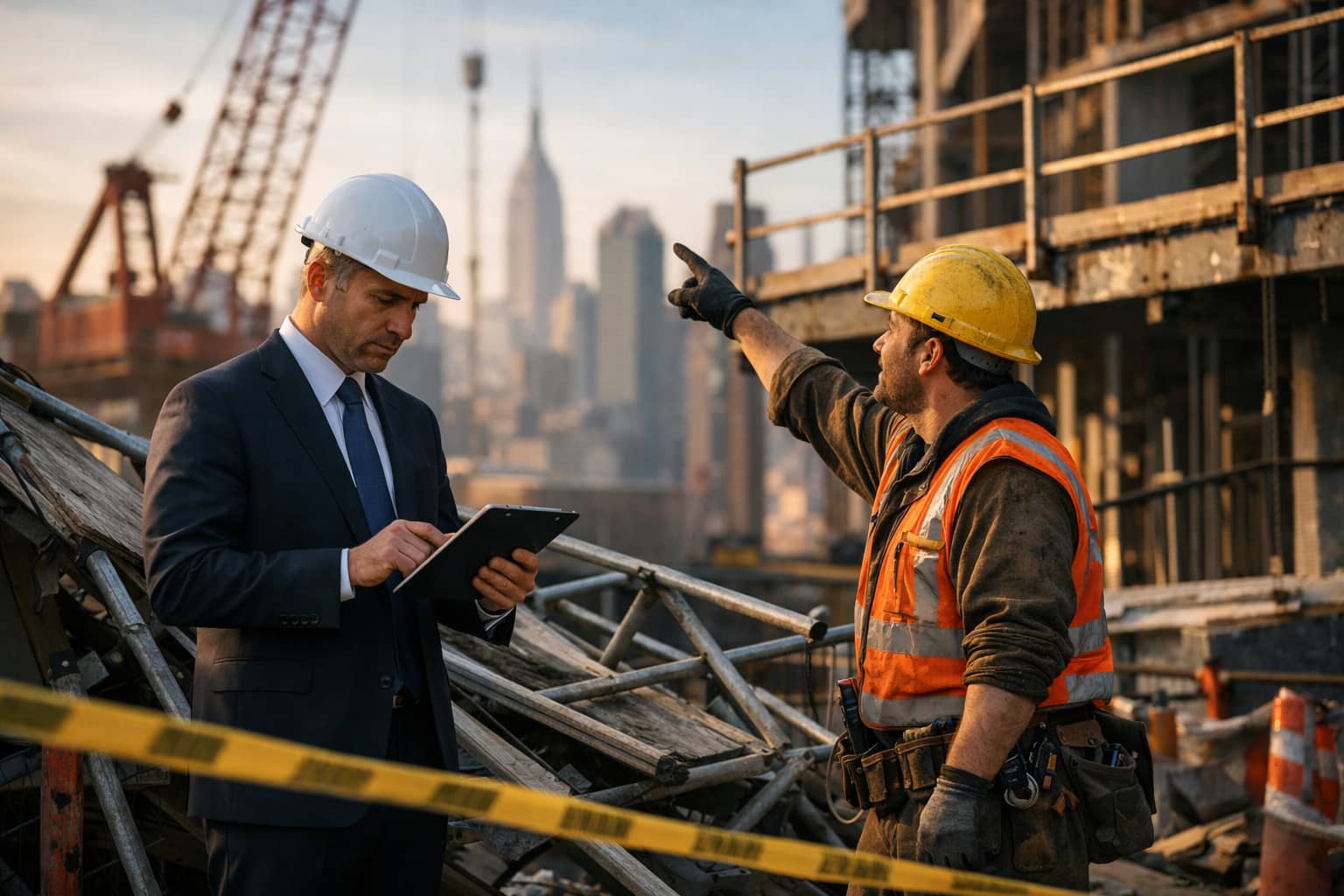
New York's construction safety laws create some of the strongest worker protections in the country. When you suffer an injury on a construction site, these statutes determine who can be held accountable and how much compensation you can recover. At The Perecman Firm, we've built our reputation over 40-plus years on deep knowledge of Labor Law Sections 200, 240, and 241. These laws aren't just legal jargon to us.
They're the tools we use to secure millions of dollars in benefits for injured construction workers across New York City, Queens, and Long Island. Understanding how these three laws interact and overlap can reveal rights you didn't know you had after a workplace accident. Each statute serves a distinct purpose, but together they create a comprehensive safety net that holds property owners and contractors accountable. If you've suffered an injury on a construction site, consider reaching out to a lawyer for guidance on the laws that apply to your situation.
Key Takeaways: New York Construction Safety Laws Working Together
- Labor Law 240 provides strict liability for falls from heights and falling objects, offering the strongest protection for injured workers.
- Labor Law 241 applies when contractors violate specific safety regulations found in New York's Industrial Code.
- Labor Law 200 addresses general workplace safety and requires proving negligence or supervisory control over the work.
- Multiple Labor Law sections often apply to a single construction accident, strengthening your overall claim.
- Property owners and general contractors face liability under these laws even if they didn't directly employ you.
- Understanding applicable Labor Law sections determines your legal strategy and the compensation you can recover.
- Call a construction accident attorney who knows how to leverage all three statutes to maximize your recovery.
The Foundation: What These Laws Were Designed to Do
New York enacted construction safety laws over a century ago in response to high rates of worker injuries and deaths. These statutes place responsibility for safety on property owners and contractors, not just the immediate employers. They require those with the most control over construction projects to maintain safe working conditions, piercing through layers of contracts and subcontracting.
Unlike workers’ compensation, which provides limited no-fault benefits, the Labor Laws allow injured workers to pursue full damages, including pain and suffering. Courts interpret these statutes broadly to protect workers in one of the most dangerous professions. The three sections create overlapping protections, giving injured workers multiple legal theories to seek compensation when accidents involve contractors, subcontractors, and property owners.
Labor Law 240: The Scaffold Law
Section 240, known as the Scaffold Law, provides powerful protections for New York construction workers, imposing absolute liability on contractors and property owners for elevation-related accidents. The law requires proper scaffolding, ladders, hoists, braces, or other devices to protect workers from gravity-related risks.
Strict liability means you do not need to prove negligence, only that the accident occurred due to inadequate protection and the defendant is a covered owner or contractor. Section 240 protects workers from falls from heights, falls through unprotected openings, and injuries from falling objects.
Elevation-differential accidents, such as falls from platforms without guardrails, also qualify. The sole cause defense is the only way defendants may avoid liability, but it is extremely difficult to prove. Courts consistently reject shared negligence arguments when employers fail to provide adequate protection.
Labor Law 241: Specific Safety Regulation Violations
Section 241 protects construction workers by requiring contractors and property owners to provide reasonable and adequate safety measures according to New York’s Industrial Code. Unlike Section 240, liability under 241 depends on proving a specific code violation that contributed to the accident.
- Fall protection violations: Missing guardrails, absent safety harnesses, or insufficient scaffolding where the Industrial Code mandates protection.
- Trench safety violations: Failure to use proper shoring, sloping, or protective systems in accordance with code standards.
- Lighting violations: Work areas that do not meet the Industrial Code’s required illumination levels increase the risk of accidents.
- Equipment safety violations: Machinery, tools, or electrical equipment that fail to comply with code requirements, including guard requirements, maintenance standards, or operational standards.
- Proving liability: Once a specific code violation contributes to the injury, the law establishes liability without requiring proof that the defendant knew or should have known about the hazard, giving injured workers strong legal protection.
Labor Law 200: General Workplace Safety
Section 200 establishes the common law duty of property owners and contractors to provide a reasonably safe workplace. It applies to all construction accidents, not just those involving elevation or code violations. Unlike Sections 240 and 241, proving liability under 200 requires showing negligence, such as creating a dangerous condition, having actual or constructive knowledge of it, or exercising supervisory control over the work.
Supervisory control is key: Property owners who hire contractors usually avoid liability unless they actively direct the work. General contractors who control methods or supervise work can be liable for unsafe conditions. Section 200 also covers premises defects and defective equipment when the defendant had control and knowledge of them. This statute provides a path to recovery for accidents outside the narrower protections of Sections 240 and 241.
How the Three Laws Overlap in Real Accidents
Many construction accidents involve multiple Labor Law sections, and understanding these overlaps can maximize recovery and provide backup claims if one theory fails.
Falls from Scaffolds
A worker who falls from a poorly secured scaffold may trigger Labor Law 240 due to the elevation hazard. If the scaffold violates specific code requirements, Section 241 applies. Section 200 may also be relevant if the defendant exercised control over scaffold erection and knew or should have known about the hazard.
Trips and Premises Hazards
A carpenter who trips on debris and falls through an unguarded opening may have multiple claims: Section 240 for missing guardrails, Section 241 for code violations requiring those guardrails, and Section 200 for failure to maintain a safe work site.
Crane Accidents
Crane accidents can implicate all three sections: Section 240 for falls at height, Section 241 for maintenance code violations, and Section 200 for unsafe conditions created by contractors. Multiple claims create strategic advantages and ensure coverage under various circumstances.
Who Can Be Held Liable Under These Laws
The Labor Laws extend liability to property owners and contractors who might otherwise avoid responsibility for worker injuries, helping identify all potential defendants. Property owners include individuals, corporate owners, landlords, developers, and government entities overseeing construction on public property.
General contractors are liable under all three Labor Law sections due to their supervisory role and control over the site, regardless of the subcontractor that employs the injured worker. Subcontractors can be liable when they control part of the work site or create hazardous conditions, such as a roofing subcontractor responsible for fall protection.
Construction managers may face liability depending on their authority over site operations and safety. Architects, engineers, and equipment providers are generally not liable unless they direct work methods, supervise safety, or control equipment use. A defendant’s lack of a contractual relationship with your employer does not shield them from Labor Law responsibility.
Exceptions and Defenses to Labor Law Claims
New York’s Labor Laws strongly protect injured workers, but certain defenses and exceptions can influence claims and set realistic expectations. The sole cause defense applies mainly to Section 240, allowing a defendant to avoid liability if they prove the worker’s actions alone caused the accident despite providing safety equipment, though this rarely succeeds.
The recalcitrant worker doctrine may shield employers when injuries result solely from a worker’s refusal to follow clear safety instructions. Homeowner exemptions limit Sections 240 and 241 claims for single- or two-family dwellings, while Section 200 still applies under negligence theories.
Independent contractor shields can protect owners under Section 200 but not Sections 240 or 241. Coverage depends on whether the work qualifies as construction, renovation, or repair, and on the worker’s status as an employee or contractor performing covered work. Even under strict liability, you must show causation—the violation must contribute to the accident.
Calculating Damages Under Different Labor Law Sections
The Labor Law section under which a worker prevails does not alter the categories of damages available, but it can significantly influence settlement values and jury awards. All three statutes allow recovery of medical expenses, lost earnings, future medical needs, future lost earning capacity, pain and suffering, and loss of enjoyment of life.
Section 240 cases often generate the highest recoveries due to strict liability, putting pressure on insurance companies to settle substantial claims. Falls or injuries from falling objects causing permanent disabilities, paralysis, traumatic brain injury, or amputations frequently result in multi-million dollar settlements. Section 241 claims typically produce slightly lower recoveries because proving specific Industrial Code violations requires more evidence and allows defendants to contest liability, though severe injuries still yield significant awards.
Section 200 claims generally settle for less because negligence standards give defendants more room to argue shared fault or insufficient supervision. In practice, most construction accident cases resolve through settlement, with values reflecting the strength of the legal claims, the severity of injuries, and the defendant’s exposure to potential jury verdicts under strict liability or code-based standards.
Why Legal Guidance Matters for Labor Law Claims
Construction accident cases under Labor Laws 200, 240, and 241 are complex and require legal knowledge beyond standard personal injury work. Properly handling these claims involves detailed investigation, analysis, and strategy.
- Identify applicable statutes: Analyze accident facts in light of decades of case law to determine the applicable Labor Law sections and how they intersect.
- Develop evidence: photograph the scenes, interview witnesses, obtain code violation reports, and hire safety consultants to build a comprehensive case.
- Prove Industrial Code violations: Research specific provisions for Section 241 claims and demonstrate how breaches contributed to the accident.
- Handle defenses and technical challenges: Counter sophisticated arguments from experienced defense attorneys with courtroom-tested strategies.
- Maximize recovery: Accurately value claims, negotiate liens, coordinate with workers’ comp, and structure settlements to protect your interests and compensation.
Securing Justice With The Perecman Firm
For over 40 years, our firm has focused exclusively on construction accident cases, helping injured workers navigate New York’s complex Labor Laws. We’ve achieved multiple multi-million-dollar settlements, including $15.2 million for a scaffolding fall, $12 million for a ladder accident, and $11.8 million for a suspension scaffold incident.
Our ranking in U.S. News’ Best Law Firms highlights our ability to strategically apply Sections 200, 240, and 241. Clients praise our team for knowing exactly what laws apply and how to leverage them.
Operating from Manhattan and serving workers across New York City, Queens, and Long Island, the trusted attorneys at Perecman Firm transform Labor Law protections into meaningful recovery. If you witnessed or experienced a construction accident, contact our attorneys today for a free consultation and learn how your rights and evidence can make a real difference in securing compensation.
FAQ: New York Labor Laws 200, 240, and 241
Can Labor Law 240 apply if I fell less than six feet?
Yes, there's no minimum height requirement. Courts have found Section 240 applicable to falls from relatively short distances as long as the elevation differential and inadequate safety protection caused the injury.
What happens if both Labor Laws 240 and 241 apply to my case?
You pursue both claims simultaneously. Multiple legal theories strengthen your position and provide backup if one claim faces unexpected challenges. Settlements and verdicts don’t differ based on the specific statute under which you prevail.
Do Labor Laws 200, 240, and 241 apply to workers on private residential projects?
Sections 240 and 241 have limited homeowner exemptions for work on owner-occupied one or two-family homes. Section 200 applies to all construction work. Commercial projects and larger residential buildings are not exempt.
Can I recover under the Labor Law if I was working as an independent contractor?
Yes, these laws protect both employees and independent contractors performing covered construction work. Your employment status affects workers' comp eligibility, but not your rights under Labor Laws 200, 240, and 241.
How long do I have to file a Labor Law construction accident claim?
The statute of limitations for personal injury claims in New York is generally 3 years from the date of the accident. However, starting the legal process early preserves evidence and strengthens your case substantially.